By
ETCentricJanuary 10, 2015
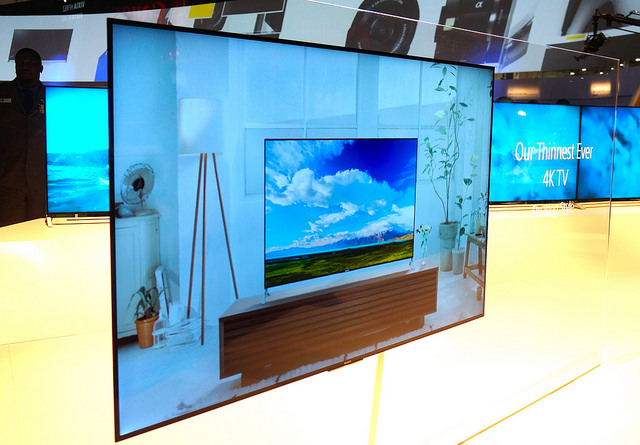
Sony went all in on 4K this year, with compelling ways to watch and create UHD content. Its 55- and 65-inch XBR-X900C is its thinnest LCD TV to date with a unique design that makes it appear as if it is floating. To provide some context, the X900C has a miniscule depth of 7.1mm, which is thinner than LG’s 55-inch OLED TV — in fact, it’s thinner than the iPhone 6 (check it out via videos from Digital Trends and CNET). Sony also introduced some affordable 4K camcorders, scheduled for February availability, including the $500 FDR-X100V 4K Action Cam, a GoPro rival that shoots Ultra HD video at 30fps, 1080p at 120fps or 720p at 240fps. “Bigger — but not by much — is the new HDR-AX33 Handycam, which is the smallest handheld 4K camcorder Sony has released to date,” reports Wired. The $1,100 camera “shoots 3,840 x 2160 XAVC S video at 30p and 24p, and it has built-in Wi-Fi that enables it to live-stream footage to Ustream.”
By
Rob ScottJanuary 9, 2015
During the LG press conference at CES earlier this week, Netflix announced that it plans to introduce high dynamic range (HDR) to its 4K UHD streaming sometime this year. While a specific timeline was not revealed, it is expected that the HDR streaming will coincide with the launch of LG’s much talked about OLED TVs. Netflix support for HDR was also announced with Sony; the company’s X900C ultra-thin UHD TV showcased at CES will run on the new Android TV platform and provide access to Netflix 4K. Continue reading Netflix to Introduce High Dynamic Range to its 4K Streaming
By
Erick Mendoza January 9, 2015
United Talent Agency has developed a measurement tool to track and rank movies based on the social media buzz they accrue in the 365 days up until the film’s release date. Using data provided by Twitter, UTA determines and assigns a ranking for every move on a scale of 1-100. For 2014, UTA observed a pattern by which higher ranked movies outperformed lower ranked movies at the box office. The correlation between a movie’s social media numbers and box office performance however, does not imply causation. Continue reading CES: UTA Talks the Importance of Social Data in Hollywood
By
Erick MendozaJanuary 9, 2015
A group of Sony engineers have launched a platform called MESH (Make, Experience and Share) that allows people to create “smart projects” with the simplicity of a tablet and small wireless tags. The MESH group presented its DIY kit at CES this week alongside other startups in Eureka Park. The platform uses four Bluetooth-enabled devices that can be programmed using a simple drag-and-drop system on a tablet to remotely water plants, activate lights and sound, and handle a variety of creative applications. Continue reading CES: Sony Tablet Platform MESH to Simplify Smart Projects
By
Don LevyJanuary 9, 2015
CEA gathered a panel of four significant leaders at CES to discuss the current state of the Internet of Things. Panelists from Cisco, Verizon, the city of Los Angeles, and the Zigbee Alliance all see momentum building for a connected world; however, at this still early stage of adoption the most significant and meaningful inroads are happening on a macro scale. As Cisco’s John Chambers noted during a CES keynote panel, the Internet of Everything becomes most meaningful when there is broad participation. Continue reading CES Panel: Is the Internet of Things Poised to Make History?
By
Debra KaufmanJanuary 8, 2015
HDR (High Dynamic Range) — which enables a greater range of luminosity that results in enhanced color and contrast — was a feature demonstrated on numerous TV displays at the 2015 CES in Las Vegas. A panel looking at “HDR: Hollywood’s New Creative Tool” brought together studio execs, technologists and display manufacturers to talk about HDR’s advantages and the obstacles in achieving wide adoption. Panelists discussed the new Ultra HD Alliance, the need for standards, and much more. Continue reading CES Panel Discusses HDR as Hollywood’s New Creative Tool
By
Phil LelyveldJanuary 8, 2015
Japanese startup FOVE has developed a virtual reality head-mounted display with built-in eye tracking. The eye tracking enables the software to render the areas where the viewer is not looking with less precision than the area where the viewer is staring, allowing for more efficient CPU/GPU resource utilization. The rendered image was very clear, and the eye tracking worked well. When the headset goes to market, a FOVE rep expects the HMD with headtracking to sell for $400-$450. Continue reading Startup Demos New Eye Tracking Virtual Reality HMD at CES
By
ETCentricJanuary 8, 2015
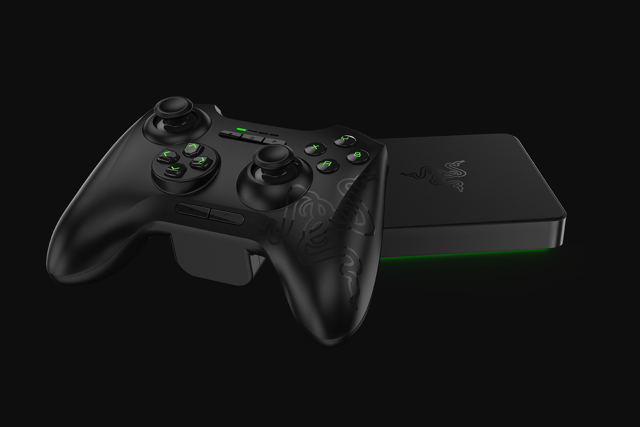
Gaming tech company Razer unveiled the Android-based gaming console it first announced during Google I/O last year. The $100 Razer Forge TV, due out in Q1, is a 4×4-inch micro-console designed to serve “as a platform for hardcore PC gaming, for Android gaming, and for Android-based entertainment services via Google Play,” according to TechCrunch. “The Forge TV will run on Razer’s Cortex: Stream (out in spring 2015) and focuses on low-latency and HD resolution, which the company says will help the device cut down on some of the lags and other hiccups that have plagued other streaming services.” The console features quad-core processing, a high-end graphics engine, wireless and network connectivity, and 16GB of internal storage.
By
Rob ScottJanuary 8, 2015
Polaroid has unveiled its portable Zip device, a 6.6-ounce photo printer, less than one-inch thick, that creates 2×3-inch prints using the company’s ZINK zero-ink technology and adhesive-backed ZINK paper. The pocket-sized device enables users to print photos from Bluetooth-enabled smartphones and tablets. The Zip includes a free mobile app available for iOS and Android, and an array of editing options such as adding filters, frames, stamps and stickers. Users can even make business cards. The Zip is expected to ship this spring for about $130. Continue reading CES: Polaroid Demos New Pocket-Sized Mobile Photo Printer
By
Don LevyJanuary 7, 2015
The Internet of Things is only meaningful when it really encompasses everything. This was the key refrain throughout the CES keynote panel “Fast Innovation: Disrupt or be Disrupted” featuring John Chambers, Cisco chairman and CEO, Neil Smit, president and CEO of Comcast Cable and Werner Struth, member, board of management, Robert Bosch GmbH. David Kirkpatrick, founder, host and CEO of Techonomy moderated the discussion on the evolution of the connections between people, data, business and innovation. Continue reading CES Panel: The Internet of Everything and Full Participation
By
Rob ScottJanuary 7, 2015
Mozilla is planning to take on industry leaders Apple and Google by developing a version of its Firefox operating system specifically for wearables. Firefox OS, which is starting to appear in smartphones and select TVs, will be adapted for use in smart glasses, smartwatches, and other wearable devices as an alternative to Google’s Android Wear or Apple’s iOS. Mozilla’s ultimate goal is to provide Firefox OS as a system to easily connect appliances, mobile devices, television sets and wearables, regardless of their OS. Continue reading Firefox OS for Wearables as Alternative to Android and iOS
By
Debra KaufmanJanuary 7, 2015
A group of movers and shakers in the MEMS/sensors industry gathered during a day-long conference at the 2015 CES in Las Vegas yesterday to discuss how their technologies need to evolve in order to enable a smart Internet of Things. Panelists addressed the need for improved sensing technologies, smaller form factors and better integration. Companies represented during the early afternoon session included SunEdison Semiconductor, IBM, Evernote, ARM and virtual reality startup Virtuix. Continue reading Tech Session: Developing MEMS and Sensors for a Smart IoT
By
Debra KaufmanJanuary 7, 2015
Developers of health and fitness wearables — currently the industry’s biggest segment — are challenged with providing accurate and reliable biometric information. If the consumer cannot be convinced that calories burned, steps taken, and blood pressure numbers do not reflect reality, then health and fitness wearables will never gain the traction they need to become mass market. Enter Valencell, a core technology provider for biometric information to silicon providers and OEMs. Continue reading Sensors/MEMS Session: Biometric Information for Wearables
By
Rob ScottJanuary 7, 2015
Samsung Electronics plans to extend its Tizen operating system beyond mobile phones to its new smart TVs beginning next month. At CES, Samsung CEO BK Yoon announced that Tizen TVs would initially launch in the U.S. and Korea, followed by a rollout to additional international markets later in the year. Samsung, which has spent years developing Tizen as an alternative to Google’s Android mobile operating system, is looking to better compete in software and services with OS leaders Google and Apple. Continue reading Samsung Targets Google and Apple with Plans for Tizen TVs
By
Erick Mendoza January 7, 2015
Facebook has reportedly acquired Wit.ai, a Palo Alto-based startup with an API that allows developers to make use of voice recognition and natural language processing technology for their products. Although Facebook has not yet disclosed any details about Wit moving forward, it seems that the social network’s instant messaging app Messenger will likely be a part of the plan. The voice recognition technology that Wit provides Facebook is in line with that of Apple’s Siri. Continue reading Social: Facebook Acquires Startup with Siri-Like Technology