Crowdtilt CEO Predicts Top Tech Startup Trends for 2013

James Beshara, co-founder and CEO of Crowdtilt.com, anticipates five top trends for tech startups in 2013: 1) phones will become our remote controls for life; 2) crowdfunding behavior will expand; 3) we will experience a new era enabled by sensors; 4) large companies within the startup ecosystem will seek new business models; and 5) a consolidation of entrepreneurs will come together to build companies. Continue reading Crowdtilt CEO Predicts Top Tech Startup Trends for 2013

Home Entertainment: Distribution Models Finally Working Together

In the home entertainment space, consumer spending on software rose for the first time since beginning a steady decline in 2006. The Digital Entertainment Group reports that at the end of the third quarter 2012 consumer spending on home entertainment as a whole — including disc, rental and digital distribution — was up by about 1 percent. IHS Screen Digest predicts that spending will total $18.7 billion, 5 percent higher than last year. Continue reading Home Entertainment: Distribution Models Finally Working Together

CES 2013: Expect Connected Game Devices and Cameras

Although E3 has become the premier launching pad for all things video games, Microsoft spent a significant amount of its final keynote address at last year’s CES touting the place of Xbox in the home entertainment landscape. Gaming consoles could very well be the ultimate smart TV upgrade by providing Internet access and a pipeline for media through an ever-expanding app selection. Continue reading CES 2013: Expect Connected Game Devices and Cameras

CES 2013: Innovation in Digital Health and Fitness Technologies

The ETC will be at CES 2013 where more than 215 exhibitors will showcase the latest digital health and fitness technologies, a 25 percent increase from 2012. With innovative devices and more than 44 million apps expected for download in 2013, the health and wellness category is a serious player in the digital arena. ETC will explore the role and opportunities for entertainment as fitness moves from grind to games and health and wellness shifts from routine to ritual. Continue reading CES 2013: Innovation in Digital Health and Fitness Technologies

CES 2013: LG to Unveil Seven Google TV Models

LG has confirmed it will launch new Google TV offerings at CES next week, including 42-, 57-, 50-, 55- and 60-inch models from the upcoming GA6400 series, and 47- and 55-inch Cinema Screen panels from the new GA7900 series. Features include: Magic Qwerty Remote, natural language recognition via a built-in microphone, and built-in Google search functions. An updated Home Dashboard offers convenient access to content from HBO Go, YouTube and other apps. Continue reading CES 2013: LG to Unveil Seven Google TV Models

Year in Review: Top Tech Policy Stories of 2012

From Kim Dotcom and the rise of patent troll lawsuits to Apple v. Samsung and the public outcry against SOPA/PIPA, 2012 was a dramatic year in terms of copyright law, tech-related legislation and Internet policy. Response to the SOPA/PIPA bills in January helped set the tone as the debate in Washington raged, and consumers and companies took to the Internet in protest. At one point, politicians were flooded with a record eight million e-mails from regular Internet users in just a few days. So what were the top tech policy stories for 2012 — and how will they impact us moving forward? Continue reading Year in Review: Top Tech Policy Stories of 2012

Tim Bajarin Details Top Six Tech Trends Expected in 2013

Industry analyst Tim Bajarin offers his perspective on the leading tech trends we can expect in the coming year. Bajarin, who has been writing an end-of-the-year prediction column for 23 years (and says he has been “reasonably successful”), predicts some interesting developments, including: Augmented Reality going mainstream, increased consumer attention for Google’s Chromebook, a new interest in hybrids and convertibles from IT managers, a dramatic increase in mobile malware, and more. Continue reading Tim Bajarin Details Top Six Tech Trends Expected in 2013

NPD Study: Consumers Slow to Adopt Apps on Smart TVs

Research organization NPD estimates that approximately 25 million U.S. households currently have smart TVs. While nearly six out of 10 owners are using their smart TVs to watch over-the-top video services such as Netflix and Hulu Plus, and roughly 15 percent are accessing music services like Pandora, the majority of Americans are not utilizing applications beyond streaming video and music. The latest NPD Connected Intelligence Application & Convergence report suggests the Internet connected HDTV screen has yet to reach beyond its TV-centric heritage. Continue reading NPD Study: Consumers Slow to Adopt Apps on Smart TVs

CES 2013: LG to Push Cloud and Second Screens in Las Vegas

In a five-minute video interview with Beet.TV, Matthew Durgin, director of Smart TV Partnerships at LG, discusses the LG Cloud designed for interaction with LG Smart TVs, the emergence of second screen apps and new content partnerships for the company’s two-screen API. The API allows users to manage and interact with programming on their televisions using an app on their tablet or smartphone. LG has been making the two-screen solution available to some of its content partners who have been implementing it to enable surfing content on a smaller screen and then pushing the content to the main screen. Continue reading CES 2013: LG to Push Cloud and Second Screens in Las Vegas

For the Cost of a Bicycle, Parents Can Purchase Kid-Friendly Tablets

For around $200, parents can buy their kids child-appropriate tablet computers. According to The New York Times, children “understand that this single device is a million-channel TV, music collection, game machine, camera and e-book library, and a way to socialize with friends.” The article reviews 21 different kid-friendly tablets, including the $150 Android-powered Kurio 7, MEEP and Tabeo tablets. “The Nabi 2 costs a bit more ($200) but has a noticeably better screen,” suggests the article. “The Nabi Jr. ($100) is smaller and can double as a baby monitor.” Continue reading For the Cost of a Bicycle, Parents Can Purchase Kid-Friendly Tablets

FAVI Ships SmartStick: All-in-One Smart TV, Home Theater and PC

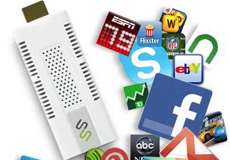
FAVI Entertainment recently announced it is shipping its plug-and-play SmartStick HDTV enhancer, which it claims is “your Smart TV, Home Theater and PC all rolled into one.”

“Like Roku’s Streaming Stick, it’s a media player that’s been squeezed into a dongle-sized form-factor, running Android 4.1 and packing apps like Netflix along with the Plex media server, a full Web browser and DNLA,” reports Engadget.

The SmartStick streams media through the television’s HDMI port and connects to additional devices wirelessly. “You can even add a $40 wireless keyboard to avoid the usual finger calisthenics,” notes the post.

According to the press release, the device offers apps such as Netflix, HBO Go, Epix, Pandora, Spotify, YouTube, Pinterest, Facebook, Twitter and others. The 4GB device is priced at $50, while an 8GB version costs $80.

“Included with the SmartStick is the Plex app where you can wirelessly deliver videos, documents, music, images, movies directly to your SmartStick enabled television making your TV a hub of entertainment — no subscription needed,” according to the release.

Wireless Game-Changer: FCC Proposes Airwave-Sharing Scheme

A new spectrum sharing rule proposed by the Federal Communications Commission would be the biggest wireless regulatory change in decades and could prove a pivotal move in addressing ever-increasing data traffic. “Under the proposed rule, wireless carriers, corporate offices, or researchers could reserve pieces of that spectrum in different regions and at different times — a system managed by a central database,” Technology Review explains.

“The approach guarantees that the spectrum will be available and not subject to interference in certain areas by a crush of new users, as might happen if the new chunk of spectrum were made available with no regulation at all.”

The step “is a critical milestone,” says David Tennenhouse, Microsoft’s VP of technology policy. In addition to releasing more spectrum, the rule will enable “dynamic spectrum sharing that is particularly well suited for absorbing growing wireless data traffic,” he says.

“Cisco Systems estimates that mobile data traffic will grow by a factor of 18 by 2016, and Bell Labs predicts it will increase by a factor of 25,” notes the article. “Many more airwaves could eventually be shared with the help of cognitive radios, which sense available frequencies and shift between them.”

The rule applies to spectrum in the 3.550 to 3.650 gigahertz band, which is currently used by radar systems. At first, the “checked-out” spectrum might be free, but a pricing system may eventually be implemented to allow a wireless carrier to pay for priority access in times of extreme high demand.

“Whatever the details, the move spells the beginning of the end of a system in which spectrum is either exclusively owned by a private company, walled off for government and military use, or unlicensed and crowded,” suggests the article.

Digital Downloads: Kaleidescape Plans to Offer Time Warner Movies

  • Kaleidescape Inc. originally looked to reduce the hassle of physical DVDs and Blu-ray discs by enabling consumers to copy the movies and save them to a hard drive. After being sued by the DVD Copy Control Association, the company has since revamped its business model to keep up in the digital age of downloads.
  • “The closely held company plans to let users of its hardware buy and download digital movies, while still being able to make and store copies of DVD and Blu-ray discs they own,” the Wall Street Journal writes. “Kaleidescape is initially stocking its first online store with movies licensed under a multiyear deal with Time Warner Inc.’s Warner Bros. movie studio.”
  • With numerous services that offer movies for rental, purchase or streaming, Kaleidescape is notably pricey.
  • “Kaleidescape’s systems, designed for people installing fancy home theaters, start at $14,490,” the article states. “But Kaleidescape hopes to build its audience among affluent customers who are willing to pay extra for the highest quality content, a sophisticated program guide and other features. Unlike most online video stores, the company says, its downloads will include all extra scenes and additional content found on DVD or Blu-ray discs.”
  • The deal with Time Warner provides the service with 3,000 feature films and more than 8,000 TV episodes, which will be priced between $6 to $20. Kaleidescape plans to enter licensing deals with other studios as well.
  • The company also supports the UltraViolet format. But downloading titles can take a while — up to five hours for a Blu-ray over a standard Internet connection.

Strategic News: Mark Anderson Delivers 10 Predictions for 2013

Forbes provides an overview of the latest computing and telecommunications predictions for 2013 from tech guru Mark Anderson, as published in his Strategic News Service newsletter.

1) Tablets or “CarryAlongs” will become the dominant segment of computing devices.

2) Intel will fade into obscurity as Qualcomm and ARM take over computing, dominating the production of mobile chips.

3) Most U.S. homes will have Internet-enabled TVs, and other developed nations will follow suit as bandwidth improves.

4) The LTE vs. fiber battle will determine carriers’ business model for the years to come. “Customers choosing broadband LTE in DSL-served regions will be paying more and getting more; but those choosing LTE in fiber-served regions will be paying more for wireless broadband but getting less.”

5) Google will become the next Apple. “Google’s efforts in email, video, smartphones, maps, and driverless cars open up new long-term expansion paths, with more to follow.”

6) The driverless car will work toward ubiquity as countries pass laws to allow it and major brands work on developing new features.

7) e-Books will substantially outpace paperback sales in 2013 and will eventually dominate the market.

8) “Enterprise IT struggles to achieve very modest gains, with executive purchase decisions captured between large cash holdings, increased Asian competition, and their own poorly performing customers.”

9) “‘Hacktivist’ efforts acquire an important and permanent role in political transparency.”

10) Supply chain security will determine global technology purchases. “Recognition that today’s supply chains are virtually all compromised will lead to plant relocations and a new set of business opportunities for onshore component makers.”
Research Team Develops LCD Display That Fits on Contact Lens

  • Researchers at the Ghent University Centre of Microsystems Technology in Belgium have developed a new contact lens that displays letters and symbols on its lens.
  • “Prior to this point, researchers have only been able to create a LED lens that displays a single pixel,” notes Digital Trends.
  • “However, the technology behind this new development offers the ability to display a large range of pixel sizes as well as a significant volume of pixels on a LCD display.”
  • “Normally, flexible displays using liquid crystal cells are not designed to be formed into a new shape, especially not a spherical one,” explains Professor Herbert De Smet, head researcher on the project. “By using new kinds of conductive polymers and integrating them into a smooth spherical cell, we were able to fabricate a new LCD-based contact lens display.“
  • Conceptually, the lens tech could be used to display scrolling text messages or emails sent to a smartphone, even GPS driving directions. The technology could also enable adaptive lenses that lighten or darken, similar to glasses that feature light-transitioning material.
  • Medical applications might include limiting light access after eye trauma or allowing more light to a damaged eye during the healing process following surgery.