NPR Music Hits a High Note with Eclectic Music Programs

Public radio broadcaster NPR, which is primarily known for its news and interview programs, has been making a name for itself in the music world. NPR is expanding its horizons with its fifth year of NPR Music, which includes online streaming and podcasts. With a variety of programs like “Tiny Desk Concert” and “All Songs Considered,” the station is providing unique opportunities for lesser known artists and established acts. Continue reading NPR Music Hits a High Note with Eclectic Music Programs
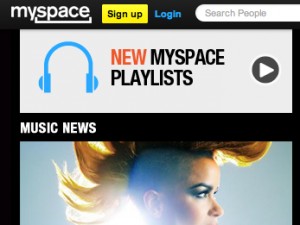
Justin Timberlake Unveils New Myspace: Is it Worth the Time?

  • Fifteen months ago, Specific Media purchased MySpace, with Justin Timberlake taking an ownership stake in the flailing social network.
  • Following months of relative quiet — with the only major news being a new Panasonic partnership announced at CES 2012 — the new Myspace (now fashioned with lower case ‘s’) has finally been revealed in a Vimeo post.
  • Timberlake tweeted a link to a video that gives a sneak preview at the new service. Included in the Mashable post, the video makes the new Myspace look “clean and attractive.”
  • It shows a new login using Facebook or Twitter that allows users to bring photos or other information from the other networks. Status updates feature large photos with comments showing up below.
  • “There is a large music component to the service, which includes a way to browse albums, find popular songs and artists and more,” the post explains, noting that it is still uncertain whether Myspace is “building its own music service or if it has partnered with a provider such as Spotify, Rdio or Rhapsody.”
  • “The biggest question I have about the new Myspace is whether or not the brand is worth anything,” writes Christina Warren for Mashable. “I’ve argued in the past that the biggest asset of Myspace is also its biggest liability. What the new owners will have to do — celebrity investor or not — is prove to users why this Myspace is worth a user’s time.”

Mossberg on iTunes Match: Store Your Songs without Slow Uploads

  • Walt Mossberg favorably reviews Apple’s iTunes Match service. For $25/year, you can create a music locker in the Cloud that allows you to play your music collection on up to 10 devices.
  • In contrast to similar locker services from Google and Amazon, you do not have to upload your entire collection — iTunes Match scans your iTunes library and matches it with its 20 million song library.
  • The service only works for digital music currently, and not for movies, TV shows or audiobooks.
  • Your locker can include up to 25,000 songs. It’s worth noting that, “Match is an optional addition to an existing free service called iTunes in the Cloud, which covers only songs you bought from Apple’s iTunes store.”
  • “In all, I like iTunes Match, and can recommend it to digital music lovers who want all their tunes on all their devices,” writes Mossberg. “It’s another nice feature of iCloud, priced reasonably.”

Beta Release: Cinefy App Provides Video Editing and Effects for the iPhone

  • Chairseven and App Creation Network recently announced the beta availability of Cinefy, “a mobile video editing and effects platform for iPhone where users create and share videos mixed with high quality visual effects,” according to the press release. “Cinefy empowers users with no editing skills to quickly insert footage, add music and apply visually stunning effects with its intuitive and simple interface.”
  • The app offers branded effects packs which opens a marketing opportunity for TV and game studios to promote in an engaging way and possibly draw “massive viral exposure.”
  • Users can export their videos to their device’s camera roll in addition to Facebook, YouTube and Vimeo. Cinefy will eventually be available for iPads and Android devices.
  • To help create soundtracks, Friendly Music has teamed up to provide a catalog of songs, “offering 100 percent legal and all rights-cleared music for personal and custom online media creations.”

Pandora Targets the Vast Majority Who Pay Little or Nothing for Music

  • Speaking at the GigaOM RoadMap conference this week, Pandora CTO Tom Conrad suggested that more than half of Americans do not pay for music each year, while 40 percent only pay about $15 annually.
  • “Conrad revealed that his company aims to monetize the vast majority of listeners who pay little or nothing per year for music,” reports TechCrunch.
  • “While there are opportunities to build businesses on the 10 percent who are willing to pay more, Pandora plans to focus on monetizing the majority via advertisements. Other music companies might be wise to target the non-paying segment as well.”
  • Pandora is working to expand across multiple areas, including “in the home, the television, the living room, the bedroom, even embedded above the ice maker on your refrigerator,” and in your car.
  • Conrad doesn’t feel threatened by Spotify’s success. “I see Spotify as largely complementary to what Pandora does,” he said. “Spotify’s CEO Daniel Ek says he thinks Spotify is the future of the record store, and that Pandora is the future of radio.”

Media Consumption: Redefining Content Ownership in a Digital World

  • An increasing number of consumers are switching to digital content for movies, music and books. The approach has benefits, including convenience and cost, but may also be leading to a loss of rights and abilities we’re accustomed to as consumers.
  • Fortune writer J.P. Mangalindan expressed concerns that systems such as Amazon’s new lending library would change the meaning of ownership since users would be relinquishing actual ownership of content in favor of a rental model.
  • The ability to stream digital content online has led to the same kind of transformation. Services such as Spotify and Netflix have allowed users the freedom of streaming content anywhere, and have made subscribing to such a model affordable and convenient.
  • GigaOM raises an interesting concern: “Apart from our simple human need to own and collect physical objects, however, there’s also the way that renting changes our legal relationship to the content we are consuming. Amazon has shown the downsides of this in the past by actually deleting copies of e-books from people’s Kindles remotely after a complaint by the rightsholder — and those were copies that people had actually bought, not rented.”
  • If we move closer to a streaming, rental-style model for all content then perhaps consumers would eventually prefer a short-term license to use content over actually owning it. But what if Netflix or Amazon decide to change their terms of service? “What if companies decide you no longer have the right to watch certain TV shows or read certain books?”

Fun App Design: 80s Music Fans Rejoice, the Mix Tape is Back

  • AirCassette is a $1.99 iPhone app that mimics the look of an audio cassette tape while playing (including the handwritten script of a label sticker).
  • “The reels actually spin and you can create and share mix tapes with your friends via e-mail or Facebook, just as we used to do back in 1986,” reports The New York Times.
  • The AirPlay-compatible app is from Finnish programmer Majasalmi, known for its “Russian Roulette” iPhone game, and features its own iTunes music interface.
  • The app includes multiple cassette designs that resemble popular blank tapes of the audio cassette era.
  • “Watching a cassette tape spin on the iPhone’s high-resolution display is oddly calming and, thanks to digital compression, the audio is far superior in AirCassette than it ever was on my Sony Walkman,” comments John Biggs in Gadgetwise.

Google to Link New Music Download Store with its Social Network

  • Google’s music download store is expected to link with Google+ within the next two weeks. However, the service may prove disappointing if the company cannot secure deals with the four major music labels.
  • Tentatively named Google Music, the service would follow in the footsteps of Spotify, which earlier this fall linked with Facebook to promote its music service.
  • The Google+ integration would allow users to recommend songs to Google+ contacts, who could then listen to those songs once for free. MP3 downloads would then be available, most likely for 99 cents each.
  • Music labels have shown hesitation about the service’s propensity to allow piracy, in addition to the lack of revenue for record companies, as the music locker is free.

Veokami Offers New Platform for Watching Concert Videos Online

  • New platform from San Francisco-based Veokami aggregates user generated videos of concerts.
  • Veokami crawls YouTube and automatically puts together a playlist of videos from a single concert.
  • Videos are then synchronized with each other to offer Veokami users the ability to switch between the different camera views that were found on YouTube, without interrupting the flow of the music. Clips can also be arranged based on audio and video quality.
  • According to GigaOM, “the goal is to extend its platform so that artists, promoters and — most importantly — fans will be able to build these pages themselves. That could end up being a very powerful promotional tool for artists as they look to show listeners what it’s like to be at one of their shows.”
  • The company’s site also suggests the tool could be useful for organizing videos from political events and conferences.

Is Skype Co-Founder Gunning for Netflix with Subscription Vdio?

  • Janus Friis, co-founder of KaZaA, Skype, Joost and Rdio (with partner Niklas Zennstrom) is working on a new online video subscription service that will be available soon in the UK.
  • According to GigaOM, Friis has been “assembling an A-team of media and Web technology experts to launch a site that seems destined to replicate the model behind their music subscription site Rdio in the video space.” Offices have been set up in Santa Monica and Europe.
  • From the follow-up Q&A: Vdio (Vee-dee-o) is in closed beta for the UK and is privately funded, while the assembled team’s experience comes from companies such as Netflix, Microsoft, TV Guide and Napster.
  • A spokesperson for Zennstrom’s VC company Atomico confirmed that Zennstrom is not involved in the project.

YouTube Merch Store to Put a New Spin on Music Discovery

  • Google has announced that through the new Merch Store feature, YouTube partners “will be able to sell artist merchandise, digital downloads, concert tickets and other experiences to fans and visitors.”
  • The Merch Store evolved from multiple partnerships: Marketing enabler Topspin will handle merchandise sales, while concert organizer SongKick will handle ticket sales. Amazon and iTunes will power transactions for music download transactions.
  • “The ability to add merchandise sales, ticket sales, digital downloads and more to an artist’s YouTube site definitely gives these sites more of an engaging presence for artists with their fans,” reports TechCrunch. “These destinations will now become more than just a way to discover music videos, but also a way to transact business and actually see the artist and buy their works.”
  • The feature should arrive in the coming weeks. YouTube will take a percentage of sales to cover costs.

First App-Album: Bjork Releases New Collection of Interactive Music

  • Innovative Icelandic musician Bjork is combining technology and music with her release of the first ever “app-album.”
  • The collection features games, visualizations and songs that allow fans to interact with the music in a unique way.
  • “The main ‘Biophilia’ app is available for free,” reports CNN Tech. “Each sub-application, which contains a song and some sort of interactive game, costs 99 cents, or $9.99 for the whole album. A non-app version of the album also is available.”
  • “Apps and iPads are just tools — they have to be human and they have to have soul,” comments the singer.
  • Article includes podcast and transcript of CNN Radio interview with Bjork.

TED Talk: Aaron Koblin Artfully Visualizes our Humanity with Data

  • Check out this fascinating TED presentation on data visualization, crowd-sourced collaborative art projects, and the interface as a narrative device.
  • “We’re collecting and creating all kinds of data about how we’re living our lives and it’s enabling us to tell some amazing stories,” says digital artist Aaron Koblin. The TED description suggests, “his works brilliantly explore how modern technology can make us more human.”
  • Compelling tweet from the opening: “19th Century culture was defined by the Novel, 20th Century culture by Cinema — the culture of the 21st Century will be defined by the Interface.”
  • The second half ties in with interactive, collaborative music videos featuring Johnny Cash and Arcade Fire, earlier reported by ETCentric.

Will Google MP3 Store Compete with Apple and Amazon?

  • Google is expected to roll out its own music store in the next few weeks.
  • It will reportedly tie into the company’s Music Beta service that allows users to upload and store their music collections.
  • Music Beta was announced after launch of Amazon’s unlicensed service, Cloud Drive. Also worth noting: “Apple got licenses for iTunes Match, which will instantly link a user’s songs to Apple’s master collection.”
  • “Its earlier negotiations with music companies, for a so-called smart locker service — a Web storage system that lets people link their digital music collections to a vast central database — broke down over financial terms and the music companies’ complaints that Google was not doing enough to curb piracy,” reports The New York Times.

Spotify Reports Significant Losses, Despite Increase in Subscribers and Revenue

  • Streaming music service Spotify, which recently partnered with Facebook, saw its revenue more than quintuple last year. However, the British company still showed losses totaling $42 million, an increase from $26 million in 2009.
  • “Spotify’s performance has been closely monitored by the music industry, which sees it as a kind of litmus test for the viability of digital music by subscription, which pays labels each time a listener streams a particular song,” reports The New York Times. “That system brings in lower royalties per song than downloads, but with a large enough listener base could in theory bring in substantial amounts.”
  • Spotify subscriptions cost about $10 to $15 per month and includes an ad-supported free version. Daniel Ek, Spotify’s chief executive, recently announced that the service had reached the 2 million mark with paid subscribers, although there are believed to be more than 10 million total users.