There’s been a lot of music news reported in recent weeks, from a collaboration between Spotify and Facebook to compelling new discovery apps including Radio Spotter from mSpot Music to emerging cloud-based services from the likes of Google, Amazon and Apple. We’ve also been watching the direction of services such as Pandora, Slacker, Rhapsody and Napster as digital music distribution continues to evolve. However, a new online service created by MP3.com founder Michael Robertson may change the way we consume radio.
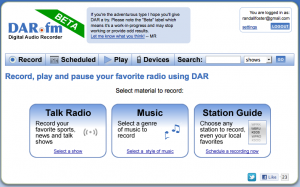 Robertson’s DAR.fm (currently in beta) is a digital audio recorder for radio content, what David Pogue describes in his New York Times column as “free TiVo for radio.” According to the site’s FAQ page: “DAR.fm is a personal recorder which records radio stations and shows to be played back at the convenience of the listener. Similar to how a DVR (digital video recorder) works with television DAR is a DVR for your radio.”
Currently, there is no charge for the basic service, but that may change in the future based on potential restrictions or data storage space (advertising on the site is also reportedly in the works). Pogue explains that each user starts with 2GB, and completing an application at MP3Tunes.com provides a free upgrade to 10GB. According to the site: “DAR.fm gives you 2 GBs of storage to record your content. This is enough to store approximately 100 hours of material. However, it depends on whether the material you’re recording is talk or music — you may be able to store more or less. If you need more space you can purchase a Premium account with 20, 50, 100, or 200 GB of additional storage.”
What makes this service compelling, however, is that users can listen to an unlimited range of radio content anywhere, anytime: via computer, phone apps, Wi-Fi-connected radios, even the Roku set-top TV box. Listening to recordings from a phone is made possible by free apps based on the open music API (Airband for the iPhone, MP3tunes for Android, Locker Player for Windows Phone 7, and Music in Your Palm for WebOS). Users can even download individual songs that have been captured.
“It’s crazy cool, like a hybrid of iTunes and satellite radio,” writes Pogue.
If DAR.fm catches on, will it compete with cloud-based and subscription music services? If it works as flawlessly as Pogue describes, it may have a strong chance, although MP3Tunes has yet to share the limelight with other more notable cloud services. Pogue writes: “The person who created DAR.fm also runs a company called MP3Tunes.com. It’s an online storage locker for your music files, so that you can play them from any computer or phone, anywhere you go. (If this sounds familiar, it’s because Amazon introduced a nearly identical service last month, called Amazon Cloud Player. Google just opened a ‘cloud music locker’ service, too. Needless to say, the headlines about this ‘new’ kind of music service drives the MP3Tunes guy crazy; his site has been in operation for four years.)”
Related Grace Digital Audio press release: “Grace Digital DAR.fm Audio Recorder for Internet Radio Debuts” (5/19/11)
Related Radio World article: “DAR.fm Hopes to Shift the Paradigm” (4/15/11)
Related Radio World article (with video): “DAR.fm, Grace Radio Aim at a ‘Talk TiVo'” (5/18/11)
Related PC Mag article: “MSpot Adds ‘Radio’ Music Discovery to Online Music Locker: Hands On” (5/26/11)
Related TechCrunch article (from Disrupt conference): “Rexly’s Social Music Discovery App Is What Ping Should Have Been” (5/23/11)